British Army
The North WaterThe British Army appears both as a force advancing through Delhi and as an institution whose influence shapes Patrick Sumner’s understanding of opportunity. The evidence gives little account of its formal organization, but it sets its military power against the pressures of battlefield care, personal advancement, and violence that its presence makes possible. The result is an institution glimpsed through what it does and what its members do, rather than through an account of its command structure.
Influence and Opportunity
Patrick Sumner arrives in the narrative as a surgeon recently returned from the Punjab, marked by an awkward manner and a limp. His medical work places him close to the consequences of military conflict, while his past connects him to the British Army’s world. In Delhi, he weighs a dangerous expedition for treasure against the practical value of remaining in the good graces of Corbyn, reasoning that the army is built on influence and that advancement depends partly on whom a man knows. His calculation presents military life not simply as service or combat, but as a network in which personal connections can govern a career. The passage does not establish Corbyn’s precise rank or describe a formal promotion system; it does show Sumner treating influence as a fact of institutional life, important enough to affect a decision he considers perilous.
That emphasis offers a counterpoint to the Army’s visible material power. Sumner’s career prospects are imagined through relationships and access, while the military presence in Delhi is registered through bombardment, advancing troops, and the physical destruction of the city. The contrast does not prove that influence alone determines advancement. Rather, it shows how Sumner understands his position: caution toward powerful acquaintances may matter as much as professional judgment when he considers what opportunities to accept or refuse.
Delhi: Battlefield and Medical Work
The British Army’s clearest collective action is its advance through Delhi during the siege. At first light, artillery fire resumes; as British troops move forward street by street, the bombardment draws closer, shaking a room and damaging its ceiling. The sequence gives military progress a material measure: the changing distance of explosions and the destruction that accompanies the advance. The Army is present here as a force operating across the city, although the account does not supply a detailed plan, identify commanders, or explain the troops’ particular objectives beyond their gradual movement forward.
The battlefield’s consequences are also registered in a hospital overwhelmed by casualties. Men arrive continually on doolies, several to a carrier, while the medical setting is crowded with the dead and wounded. The passage’s attention to the relentless arrival of patients makes treatment part of the conflict’s reality: the Army’s movement through the city and the hospital’s burden belong to the same unfolding campaign. It does not, in the evidence available here, specify the hospital’s administrative relation to the Army or describe its rules. What it does establish is the scale and repetition of military injury, and the strain that this places on those who must care for the casualties.
Influence, Violence, and Individual Conduct
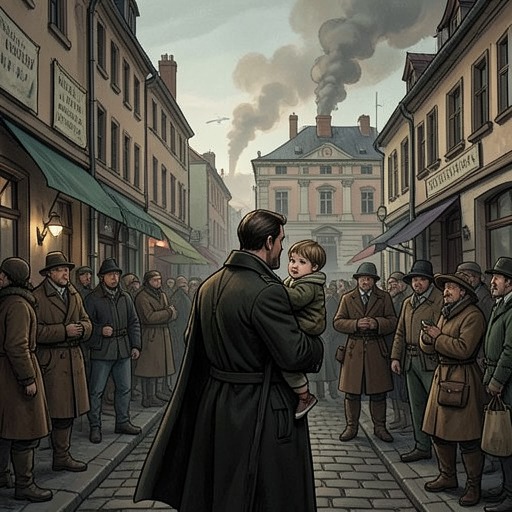
The Army’s presence does not make every soldier’s conduct representative of an official order. After the battle has moved on, Patrick Sumner and a boy encounter a British soldier carrying a pistol and a sack of loot. Sumner calls to him for assistance. The soldier looks back, notices the boy, and shoots him; Sumner then tries to help. The episode places an individual act of violence and looting in the aftermath of the advance, when the immediate battle has shifted elsewhere. It does not identify the soldier or say that his actions were authorized. That distinction matters: the scene shows what a member of the Army does, not an Army directive.
Elsewhere in the Delhi sequence, Corbyn orders several men to accompany a party, directs them to arm themselves, and tells them to return if they distrust what they find. This brief instruction shows armed personnel acting under Corbyn’s direction, but the passage does not establish his formal authority within the Army. Taken together with the soldier’s later conduct, it gives the military presence more than one register: organized action in a dangerous city, and violence committed by an individual in the disorder left behind. The narrative keeps those levels distinct rather than treating every event as evidence of a single institutional policy.
Narrative Significance
The British Army connects Sumner’s personal history and ambitions to the larger violence of the Delhi campaign. Its influence is present in his calculation about whom to know; its advancing troops and artillery shape the city he must cross; and the wounded arriving at the hospital make the human consequences of the campaign impossible to separate from medical work. These strands are linked, but they are not interchangeable: influence is Sumner’s perception of institutional life, bombardment is collective military action, and the shooting is the deed of an unnamed soldier.
The Army therefore functions less as a fully described organization than as a powerful setting for decisions and consequences. Its advance gives the Delhi episodes their immediate danger, while its association with influence places Sumner’s career within a hierarchy he believes must be navigated. At the same time, the narrative supplies no comprehensive account of its ranks, policies, or command. That limit keeps the portrait anchored to the evidence: the institution is legible through the pressure it exerts on Sumner and through the military scenes around him, not through a generalized account of the Army as a whole.